Friday, 23 October 2026

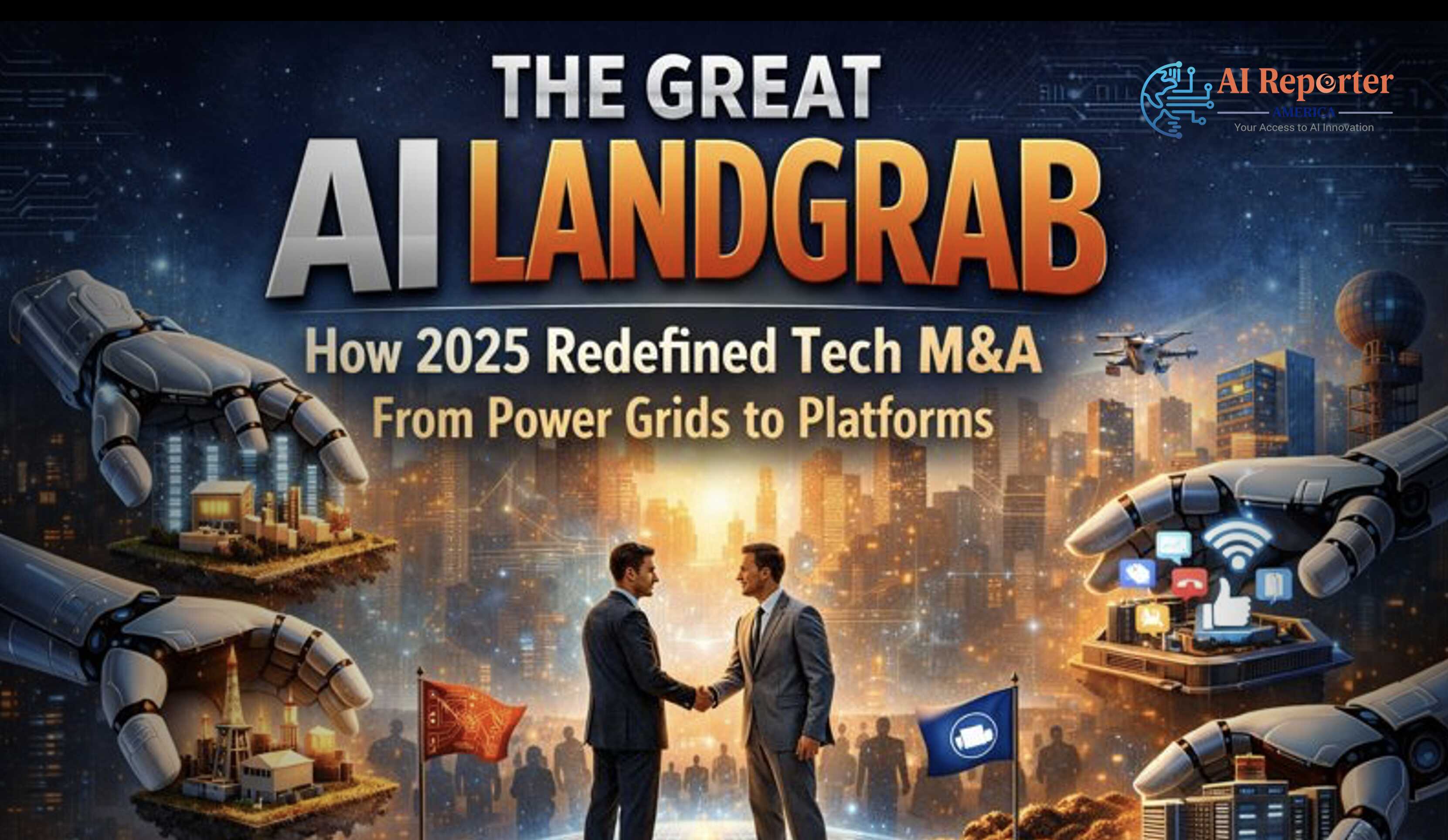
The year 2025 saw an unprecedented flurry of mergers and acquisitions across the AI and technology sectors, as companies raced to acquire strategic capabilities, talent, and infrastructure. Major tech firms and startups alike moved aggressively to expand their AI-related portfolios, blurring lines between traditional categories. For example, renewables and infrastructure became part of AI strategy when Alphabet (Google) agreed to buy Intersect Power for $4.75 billion in cash and debt – a move explicitly aimed at securing green energy for its growing AI data centers. Meanwhile, e-commerce, cybersecurity, semiconductors, and cloud platforms all became acquisition targets. These deals were not isolated gambits but part of a broader 2025 trend: AI is embedded across the deal cycle, and security, data, and talent are driving consolidation. According to Morgan Lewis, by late 2025 more than 50% of global venture capital funding was in AI, and “acqui-hires and talent wars” have become common deal drivers. In short, 2025’s AI-tech M&A was defined by strategic bets on powering the AI era – from renewable energy to next-generation chips to AI-enhanced security – setting the stage for a highly integrated, AI-driven business landscape in 2026.
Energy & Infrastructure – Alphabet / Intersect Power (≈$4.75 B): Google/Alphabet agreed to acquire U.S.-based Intersect Power for roughly $4.75 billion, plus assuming debt. Intersect is a developer of large-scale renewable energy projects. The stated rationale was “securing energy supply for its growing AI data centre fleet,” as Google rapidly expands data centers to handle AI workloads. This deal underscores a key 2025 theme: AI compute needs are driving companies to invest in power infrastructure. By owning power projects, Google can better manage supply (especially renewable energy) for 24/7 AI training and inference, which are extremely energy-intensive. The acquisition “is expected to speed up rollout of data centres and power generation capacity” for Google, and signals that utility-scale renewables are now viewed as strategic assets for tech giants supporting AI.
E-commerce & Retail AI – Flipkart / Minivet AI (majority stake): In India’s booming e-commerce market, Flipkart (Walmart-backed) announced it took a majority stake in Minivet AI, an AI/ML platform startup (founded 2024) that specializes in generative AI for shopping experiences. Flipkart described this as a “strategic move to build and invest in core Generative AI (GenAI) capabilities” as retail shifts toward more visual and interactive discovery. Minivet’s technology can turn static product catalogs into AI-generated videos and natural-language interfaces, enabling “visual-first and video-first commerce” on Flipkart. In practical terms, this means customers may soon browse products via AI-generated video demos or conversational search guided by GenAI. Flipkart’s stated goal is to “accelerate the transition to a more intuitive, interactive, and immersive shopping experience”. This deal illustrates how retail platforms are integrating generative AI to boost engagement and conversion, hinting that 2026 will see more AI-driven innovations in online shopping (personalized agents, video catalogs, etc.).
AI Chips and Data Centre Hardware – Qualcomm / Alphawave Semi: Qualcomm moved beyond mobile into data center infrastructure by closing its acquisition of Alphawave Semi, a high-speed connectivity semiconductor firm. Alphawave makes custom silicon and “chiplet” designs for high-throughput data movement – critical for AI inference and training clusters. Qualcomm CEO Cristiano Amon explained that Alphawave’s interconnect expertise “complements our Qualcomm Oryon CPU and Hexagon NPU processors,” enabling stronger platforms for next-gen AI data centers. In effect, Qualcomm can now bundle CPUs, NPUs, and high-speed interconnects together. This fits into a larger strategy (along with several other Qualcomm deals in 2025) to expand into cloud and edge AI compute. For AI workloads, data movement is as important as raw compute; Qualcomm’s Alphawave deal ensures its chips can move data swiftly between processing units. For 2026, this means Qualcomm is positioning itself to offer turnkey AI accelerator platforms (combining compute and connectivity) that could rival traditional data-center players.
Enterprise Security Software – ServiceNow / Armis (≈$7.75 B): ServiceNow, known for IT service management, struck its largest deal by acquiring Armis, a cybersecurity startup, for about $7.75 billion. Armis specializes in securing enterprise networks by scanning devices, detecting threats, and prioritizing vulnerabilities – features ServiceNow plans to integrate into its AI-driven security and operations platform. Reuters notes this was timed to help ServiceNow “counter rising cyber attacks driven by AI adoption”. In practice, the Armis technology will supply ServiceNow’s platform with device-level visibility and threat intelligence, feeding its AI-powered automation tools. For 2026, ServiceNow now has the building blocks to offer a very broad AI-enhanced security portfolio (from discovery to remediation), reflecting a sector-wide pivot: as enterprises use AI, defending AI systems has become a board-level priority.
AI Hardware Talent – Nvidia / Groq (license and hires): Nvidia did not buy Groq outright, but struck a unique deal in late 2025: it took an exclusive license to Groq’s inference chip designs and hired away key Groq personnel (including Groq’s CEO). Groq is a California startup that, like Nvidia, builds AI accelerators, but focused specifically on inference (running trained models). Nvidia’s move – essentially licensing Groq’s technology and talent without acquiring the whole company – reflects the competitive scramble for AI chip innovation. Reuters reports Nvidia licensed Groq’s chips and brought Groq’s chief architect on board, enabling Nvidia to strengthen its inference portfolio. This “acqui-hire” style move avoids regulatory hurdles of a full buyout, while still boosting Nvidia’s team. The implication for 2026: Nvidia secures new ideas for speeding up inference tasks on its chips, and Groq’s own business can continue independently. It also highlights a trend: acqui-hire deals (and IP licensing) are on the rise in AI chip and platform M&A, as firms seek talent and technology without merging entire entities.
Beyond marquee deals, 2025 saw tech giants bolstering their AI ecosystems by acquiring niche specialists and dev platforms. These moves signal focus on building end-to-end AI capabilities.
Qualcomm / Movian AI: Qualcomm acquired Movian AI (the generative AI arm of Vietnamese AI lab VinAI) in April 2025. Movian AI’s team includes VinAI researchers (led by a former DeepMind scientist) who built advanced models, including custom image generators and recommendation-optimised LLMs. Qualcomm’s CEO framed the deal as bringing “high-caliber talent from VinAI” to strengthen Qualcomm’s delivery of cutting-edge AI tools. In other words, Qualcomm is importing deep AI R&D expertise to enhance its model-development toolkit. By late 2025, Qualcomm was already talking about extending AI from mobile chips into cloud and automotive; Movian’s team will likely help Qualcomm optimize models across its hardware. This acquisition shows Qualcomm treating AI research capability itself as a strategic asset. Impact: in 2026 we can expect Qualcomm to leverage Movian’s generative AI to improve its developer platforms (e.g. for mobile AI apps) and possibly incorporate new model features into its AI SDKs.
Qualcomm / Ventana Micro Systems: In a related strategic move, Qualcomm also acquired Ventana Micro Systems (a RISC-V chip specialist). Ventana’s engineers have built “scalable, out-of-order RISC-V cores” aimed at high-performance computing. By bringing Ventana’s talent in-house, Qualcomm gains the ability to diversify beyond ARM architecture. Qualcomm’s CTO noted that adding Ventana “gives Qualcomm direct access to a mature RISC-V design team just as Qualcomm is broadening its compute ambitions beyond smartphones”. In effect, Qualcomm is hedging its future: RISC-V is an open-standard CPU architecture, and having strong RISC-V cores could be vital if customers want alternatives to ARM. Implication: Expect 2026 to see the first Qualcomm chips (likely for data centers or automotive) using RISC-V cores from Ventana, giving Qualcomm a multi-architecture strategy in AI hardware.
Qualcomm / Arduino: In a surprise October 2025 announcement, Qualcomm agreed to buy Arduino, the maker of popular open-source microcontroller boards. Arduino has a global developer community (33 million users) working on sensor and embedded projects. Qualcomm’s rationale was to “expand its reach into the global developer community and boost its position in edge and AI computing”. Qualcomm also unveiled a new Arduino UNO board (UNO Q) using Qualcomm’s own AI-focused MCU (DragonWing), illustrating the integration. By owning Arduino, Qualcomm can infuse AI capabilities into billions of “edge” devices and ensure broad developer support. Implication: In 2026, we should see Qualcomm promoting AI modules and tools through Arduino’s ecosystem, accelerating the spread of on-device AI (from smart sensors to IoT gadgets) that Qualcomm designs.
HP / Humane (AI capabilities only): Even hardware stalwarts joined the acquisitions wave. HP announced in Feb 2025 that it would acquire key AI assets from Humane, a startup founded by ex-Apple executives that created an AI wearable called the “AI Pin.” HP’s deal was asset-focused: it took Humane’s software platform (called Cosmos) and 300+ AI patents, and also brought Humane’s team into HP’s AI lab. HP’s motivation is clear: Cosmos is a gesture- and voice-driven AI operating system designed for seamless human-computer interaction. By integrating Humane’s AI OS and multimodal (speech/gesture) tech, HP “gains a ready-made platform to embed AI across its ecosystem” (PCs, printers, etc.). Unlike others, HP skipped Humane’s hardware (the Pin) and paid far below Humane’s prior fundraising, instead buying just the software and talent. Implication: This deal means HP can rapidly infuse its products with advanced AI interfaces (beyond Windows/Android). In 2026 we may see HP devices with built-in AI assistants or new gesture/UIdriven features from Humane’s tech, giving HP unique first-party AI experiences.
Cloud and platform providers raced to absorb AI tools and frameworks, enabling their customers to build AI systems more easily.
CoreWeave / Weights & Biases (≈$1.7 B): CoreWeave, an AI-optimized cloud service backed by Nvidia, completed its acquisition of Weights & Biases (W&B), a leading machine-learning development platform, in spring 2025. Reports suggest CoreWeave paid about $1.7 billion for W&B. The deal “strengthens CoreWeave’s capabilities to power AI innovation,” enabling a unified cloud stack for model development. In effect, CoreWeave customers can now access W&B’s experiment tracking, versioning, and collaboration tools seamlessly on CoreWeave’s GPU cloud. CoreWeave’s CEO stated this combination “will push the boundaries of what’s possible with AI” by merging W&B’s developer platform with CoreWeave’s infrastructure. Impact: With W&B onboard, CoreWeave can offer end-to-end MLops: from notebooks to GPU clusters. In 2026, AI developers using CoreWeave will benefit from integrated monitoring, making it easier to iterate models at scale.
CoreWeave / OpenPipe: Shortly after, CoreWeave announced it would acquire OpenPipe, a startup providing tools for training AI “agents” via reinforcement learning (RL). OpenPipe’s open-source toolkit (Agent Reinforcement Trainer) and proprietary automation help train models that learn from feedback. CoreWeave intends to “expand its platform” by adding OpenPipe’s RL capabilities, giving customers an advantage in building agentic AI systems. This fits CoreWeave’s strategy to “deepen vertical integration across its tech stack”. Impact: AI labs using CoreWeave can now natively train models with RL (improving AI reasoning/behavior over time). In 2026, as interest in autonomous AI agents grows, CoreWeave’s platform will likely be marketed as a one-stop-shop (compute + fine-tuning + RL).
CoreWeave / Monolith AI: In October 2025, CoreWeave agreed to buy Monolith AI, a UK-based startup applying AI to engineering and manufacturing challenges. Monolith’s ML models help simulate and optimize complex physical systems (e.g. materials testing, fluid dynamics) for clients like BMW and Honeywell. Merging Monolith with CoreWeave creates a “full-stack platform for industrial and manufacturing enterprises”, aiming to shorten R&D cycles. As CoreWeave’s co-founder explained, this lets engineers “better harness AI to accelerate breakthroughs” in industries like aerospace and auto. For 2026, this means CoreWeave will pitch itself to industrial customers (beyond just tech startups), positioning its cloud as a platform not only for generic AI labs but also for vertical applications (digital twins, simulation optimization, etc.).
Collectively, CoreWeave’s acquisitions (W&B, OpenPipe, Monolith) reflect a clear strategy: assemble a comprehensive AI developer stack on one cloud. By late 2025 they could advertise GPU nodes that also include tools for experiment tracking, RL training, and industry-specific modeling. In 2026, enterprise AI teams will likely find CoreWeave pitching vertically-integrated offerings: “hardware + software” bundles that cover the entire machine learning lifecycle.
Security vendors aggressively folded AI-specialist startups into their platforms, as data governance and threat protection moved to the top of board agendas. Key 2025 moves included:
F5 / LeakSignal: In March 2025 F5 (an application delivery and security company) announced it would integrate LeakSignal’s data protection tech into its product suite. LeakSignal is known for real-time data flow inspection and classification, pioneered for AI workloads. F5’s Chief Product Officer explained that integrating LeakSignal gives the F5 platform “breakground data protection and governance capabilities” to manage sensitive information in AI applications. In practice, this means F5 can now enforce fine-grained policies on data sent to or from AI services (e.g. LLM inputs/outputs), plugging critical gaps left by traditional DLP tools. This move highlights a trend: data governance is an AI priority. We should expect 2026 to see enterprises using F5’s platform to monitor AI data flows across clouds, leveraging LeakSignal’s tech for compliance and security in real time.
F5 / Fletch: In June 2025 F5 also acquired Fletch, a startup that uses “agentic AI” to process security alerts and prioritize threats. Fletch’s platform applies natural language processing and AI to sift through logs and intelligence feeds, giving human analysts clear, actionable insights. F5’s innovation leader wrote that Fletch “turns overwhelming data into real-time, prioritized insights” and that its agentic AI “will be fully integrated” into F5’s ADSP security platform. The effect: F5 customers will get automated, AI-driven threat triage built into their infrastructure. For 2026, this means F5’s security product can help human teams cut through alert fatigue by using AI assistants (e.g. “block this IP address” suggestions), a capability born of the Fletch deal.
F5 / MantisNet: In August 2025 F5 bought MantisNet, a developer of cloud-native network observability technology. MantisNet’s eBPF-based sensors provide real-time insights into encrypted container traffic – something conventional monitoring tools struggle with. F5 noted that integrating MantisNet will give organizations deep visibility and automation in cloud-native environments. In short, MantisNet will help F5 track network activity inside Kubernetes or 5G networks without performance hits. This bolsters F5’s platform by closing the visibility gap in modern architectures. Implication: By 2026, F5’s cloud platform is poised to offer seamless telemetry even in highly dynamic, encrypted environments, thanks to MantisNet’s kernel-level agents.
F5 / CalypsoAI (~$180M): F5’s most high-profile security deal was acquiring CalypsoAI for ~$180 million. CalypsoAI provides AI-specific security solutions (so-called AI “guardrails”), such as runtime protection of AI model inference and proactive “red-team” testing for adversarial attacks. F5’s press release emphasized that CalypsoAI’s “adaptive AI inference security solutions” will be merged into F5’s platform to protect AI workloads. As F5’s CEO noted: “Traditional firewalls…can’t keep up” with AI threats, so adding CalypsoAI gives enterprises confidence in running generative and agentic AI securely. By 2026, customers of F5 will likely have access to an end-to-end AI security suite – from protecting data inputs/outputs (via LeakSignal) to defending models at inference time (via CalypsoAI) – all under F5’s ADSP umbrella.
Checkpoint / Lakera: Check Point Software (a network security firm) completed its acquisition of Lakera, an AI security startup, in late 2025. Lakera’s technology detects anomalous behavior and adversarial attacks specifically in AI systems. According to World Wide Technology analysts, Check Point bought Lakera “to strengthen its AI-driven threat prevention strategy and close a key gap in network detection and response”. By embedding Lakera’s behavioral analytics into its security portfolio, Check Point can spot AI-targeted threats (like data poisoning or prompt injections) that legacy tools miss. This reinforces a broader point: as attackers start exploiting AI, security vendors are scrambling to add AI-layer defenses. In 2026, Check Point’s customers will benefit from this by having more granular AI-layer threat detection integrated into their existing security infrastructure.
Taken together, the flurry of F5 and Check Point deals underscores a 2025 theme: security and trust have become central to AI strategy. Funding for AI security and cybersecurity startups was at a multi-year peak by mid-2025, and boards are increasingly demanding AI-specific risk management. In practice, this means 2026 enterprise security products will routinely include AI governance features (data monitoring, adversarial detection, etc.) as core offerings, following the consolidation path laid in 2025.
Datadog / Metaplane: Datadog, the cloud monitoring/observability provider, acquired Metaplane in April 2025 to extend its platform into data observability. Metaplane is a machine-learning driven tool that monitors data pipelines (from databases/warehouses) to catch quality issues early. With AI initiatives growing, “trust in data quality has never been more critical,” Datadog noted. The acquisition “accelerates [Datadog’s] expansion into data observability,” unifying monitoring of applications and the data those apps use. In effect, Datadog customers can now get alerts not just on infrastructure or app errors, but also on anomalies in data feeds. For 2026, this means enterprises will have tighter feedback loops: engineers can monitor models and the data they train on from a single pane, boosting reliability of AI applications.
Alation / Numbers Station: Alation, a leader in enterprise data cataloging, acquired Numbers Station AI in May 2025 to bring agentic AI into its data intelligence suite. Numbers Station builds AI agents that navigate and analyze structured data (databases, spreadsheets) using natural language. Alation’s press release explains that combining Numbers Station’s agents with Alation’s metadata platform “enables enterprises to scale AI more quickly” and deliver more accurate, governed actions. In practice, Alation’s tools help data teams build “AI-native” analytics apps with real-time decision-making while enforcing governance. For example, an Alation user in 2026 might ask an AI agent to pull sales trends from multiple data tables; thanks to Numbers Station’s tech, the agent can understand business context and compliant to data policies. This acquisition highlights that even traditional data management companies see generative AI as a data utilization problem: merging AI agents with rich enterprise metadata to ensure the outcomes are trustworthy and auditable.
Salesforce / Informatica (~$8 B): In one of the largest tech deals of 2025, Salesforce agreed in May 2025 to buy Informatica for about $8 billion. Informatica is a cloud data management and integration leader. The deal was positioned as crucial for Salesforce’s AI ambitions: the companies said Informatica’s data governance and integration services will bolster Salesforce’s “agentic AI” strategies. Salesforce CEO Marc Benioff said the purchase will “supercharge” Salesforce’s Data Cloud, Tableau, MuleSoft etc., enabling “autonomous agents to act with intelligence, context, and confidence across every enterprise”. In short, Salesforce plans to feed its AI agents with better-curated, enterprise-grade data. The implication for 2026: CRM and business applications from Salesforce will likely feature deeper AI automation (e.g. AI sales assistants, automated workflows) built atop robust Informatica-managed data pipelines. It also signals that customer and data platforms will increasingly merge in the AI era, to ensure trusted data fuels generative AI features.
Perion / Greenbids (~$65 M): Perion, a digital advertising technology firm, in May 2025 acquired Greenbids for about $65 million. Greenbids is an AI-driven ad optimization and sustainability startup. The acquisition “enhances Perion One’s platform performance-driven capabilities through advanced AI algorithms,” according to Perion’s statements. Essentially, Perion will use Greenbids’ AI to optimize ad buying decisions and even reduce carbon footprint in ad delivery. This deal exemplifies how AI is diffusing into adtech: by 2026, Perion customers should have new machine-learning tools for campaign optimization and reporting. It also underscores that “AI meets ESG”: applying AI not just for performance but for efficiency (carbon reduction) too.
Beyond these headline deals, 2025 featured numerous smaller acquisitions and talent hires that cumulatively indicate rising AI M&A momentum. Industry trackers compiled hundreds of AI-related deals in 2025, many of them undisclosed or midsize, spanning machine vision, NLP, robotics, and workflow automation (see industry summary). For example, startups in specialized domains (e.g. AI-powered survey tools, industrial automation AI, generative video creators) were snapped up by larger firms looking to plug niche gaps. While individual citations for all these are hard to gather, their pattern is clear: AI capabilities became table stakes in every tech sector, prompting broad consolidation.
Two high-level trends tied all these deals:
AI Across the Deal Cycle: Companies are no longer just buying “AI companies”; they are embedding AI into every part of their businesses. Deals ranged from renewable energy (Alphabet/Intersect) to semiconductors (Qualcomm/Ventana) to data catalogs (Alation/Numbers) to ads (Perion/Greenbids). Morgan Lewis’s analysis notes that the focus has shifted from just developing models to integrating AI into workflows, with strategic M&A filling missing capabilities in AI, cloud security, and advanced hardware. In short, 2025 deals reflect that every tech play now expects AI inside: data platforms, developer tools, security products, and even physical infrastructure are being re-engineered around AI. For readers of this report, the takeaway is that line-by-line analysis of tech sectors is giving way to a cross-stack, AI-centric view of technology – and this will only accelerate into 2026.
Security, Trust, and Talent: A second theme is security and trust. As AI adoption soared, enterprises became acutely aware of new attack vectors and governance issues. This spurred a wave of cybersecurity M&A, as seen with Armis, LeakSignal, CalypsoAI, Lakera, and others. In the first half of 2025, funding for cybersecurity startups hit a three-year high, reflecting the urgency. We also see a surge in acqui-hire activity: many deals (like Nvidia/Groq, Qualcomm/Movian, HP/Humane) were driven largely by acquiring teams and IP rather than just products. Morgan Lewis highlights that acquiring specialized AI talent is now a core deal objective. Going into 2026, companies will likely continue using M&A as a recruiting strategy for top AI engineers and datasets, even as regulators begin scrutinizing such "backdoor" acquisitions.
The 2025 deal spree laid important groundwork for 2026. Here are key implications of these acquisitions as we look ahead:
Greener AI Data Centers: Alphabet’s Intersect buy means Google’s AI compute will increasingly run on its own renewable energy sources. By 2026, expect cloud providers (not just Google) to follow suit with “AI-ready” microgrids or power purchase commitments, as sustainable power becomes integral to AI infrastructure. In effect, renewable energy projects will be seen as strategic assets for tech firms running massive AI clusters.
AI in Everyday Experiences: Deals like Flipkart/Minivet foreshadow a future where consumer-facing services (shopping, media, social) are powered by generative AI. In 2026, we should see AI-driven, personalized shopping experiences become more common (e.g. video assistants recommending products). More broadly, AI tools acquired by platform companies (Salesforce’s Informatica, Alation’s Numbers Station) indicate that industry applications of AI will accelerate – from automated analytics in enterprise software to AI-enhanced marketing.
Diverse Compute Architectures: Qualcomm’s chipset acquisitions (Oryon CPU, Alphawave interconnect, Ventana’s RISC-V cores, plus the Arduino deal) suggest 2026 will bring new classes of AI hardware. We may see Qualcomm-branded RISC-V processors and microcontroller boards aimed at AI edge computing, offering alternatives to the existing ARM/Nvidia duopoly. Nvidia’s Groq deal hints at more specialization: expect a proliferation of inference-optimized chips and FPGAs as inference workloads expand. The key trend is heterogeneity in AI hardware, which will demand software support (one reason mobile/PCs will embed various AI accelerators in 2026).
Integrated AI Development Stacks: CoreWeave’s consolidation of W&B, OpenPipe, and Monolith points to 2026 offerings of fully integrated AI platforms. Developers will be able to spin up cloud instances that not only provide GPUs but also built-in tools for tracking experiments, performing RL, and domain-specific model training. Startups like Datadog (with Metaplane) and Alation (with Numbers Station) show that observability and data management layers will also be embedded in these stacks. In practice, this means companies will increasingly buy AI platforms rather than assembling their own tools from scratch. The result will likely be faster time-to-market for AI projects in 2026, as the ecosystem matures.
Security Becomes Default: With F5 and Check Point integrating LeakSignal, Fletch, MantisNet, CalypsoAI, Lakera, etc., next year’s products will have AI-security features by default. A development manager choosing a firewall or API gateway in 2026 can expect built-in AI governance (data classification) and adversarial detection. These acquisitions create a foundation for trustworthy AI toolkits – addressing one of Gartner’s key advice that AI TRiSM (trust, risk, security management) must be model-agnostic and cross-industry. In essence, 2025’s security M&A means 2026 will be a year where “security and compliance” are baked into any AI deployment, from cloud services to on-device AI.
Rise of Agentic AI: Several deals hint at an “agentic” trend (AI that acts autonomously). Salesforce is explicitly building agentic enterprise apps, Numbers Station’s agents tackle structured data, and CoreWeave’s OpenPipe is about training AI agents. Going into 2026, expect AI agent frameworks to become mainstream in enterprise software. Workers will interact with AI bots that can fetch data, complete tasks, and make recommendations – all under the hood of these acquisitions’ technologies.
Continued M&A Momentum: 2025’s deals were just the beginning. The Morgan Lewis report warns that the AI market is still maturing and dealmakers will remain selective. However, with AI now central, we can anticipate sustained high activity. Key areas for 2026 M&A will likely include new security startups (for emerging AI threats), specialized hardware/IP (e.g. quantum AI accelerators), and data/identity platforms (to handle data privacy in AI). Moreover, as regulators tighten scrutiny, deals may increasingly involve creative structures (licenses and minority stakes) to navigate antitrust concerns.
In summary, the landmark AI and tech deals of 2025 have built a new foundation: infrastructure deals ensure capacity and energy; developer platform deals supply tools and pipelines; security deals lock down AI risk; and integration deals embed AI into enterprise workflows. As all these acquisitions close and integrate, 2026 will see the tangible rollout of their combined effects – from greener AI data centers to smarter business apps to stronger defenses against AI risks. Organizations that invested in these capabilities in 2025 will be first-movers in 2026’s AI-driven economy, while others will feel pressure to catch up. The full significance of 2025’s M&A wave will become clear as these AI-enhanced products and services hit the market next year.
This analysis is based on publicly available information, company announcements, regulatory filings, and industry reports as of late 2025. Transaction values, strategic intent, and future outcomes reflect stated disclosures at the time of writing and may evolve as deals close, integrations proceed, or market conditions change. This article is intended for informational and analytical purposes only and does not constitute financial, investment, or legal advice.