Saturday, 03 October 2026

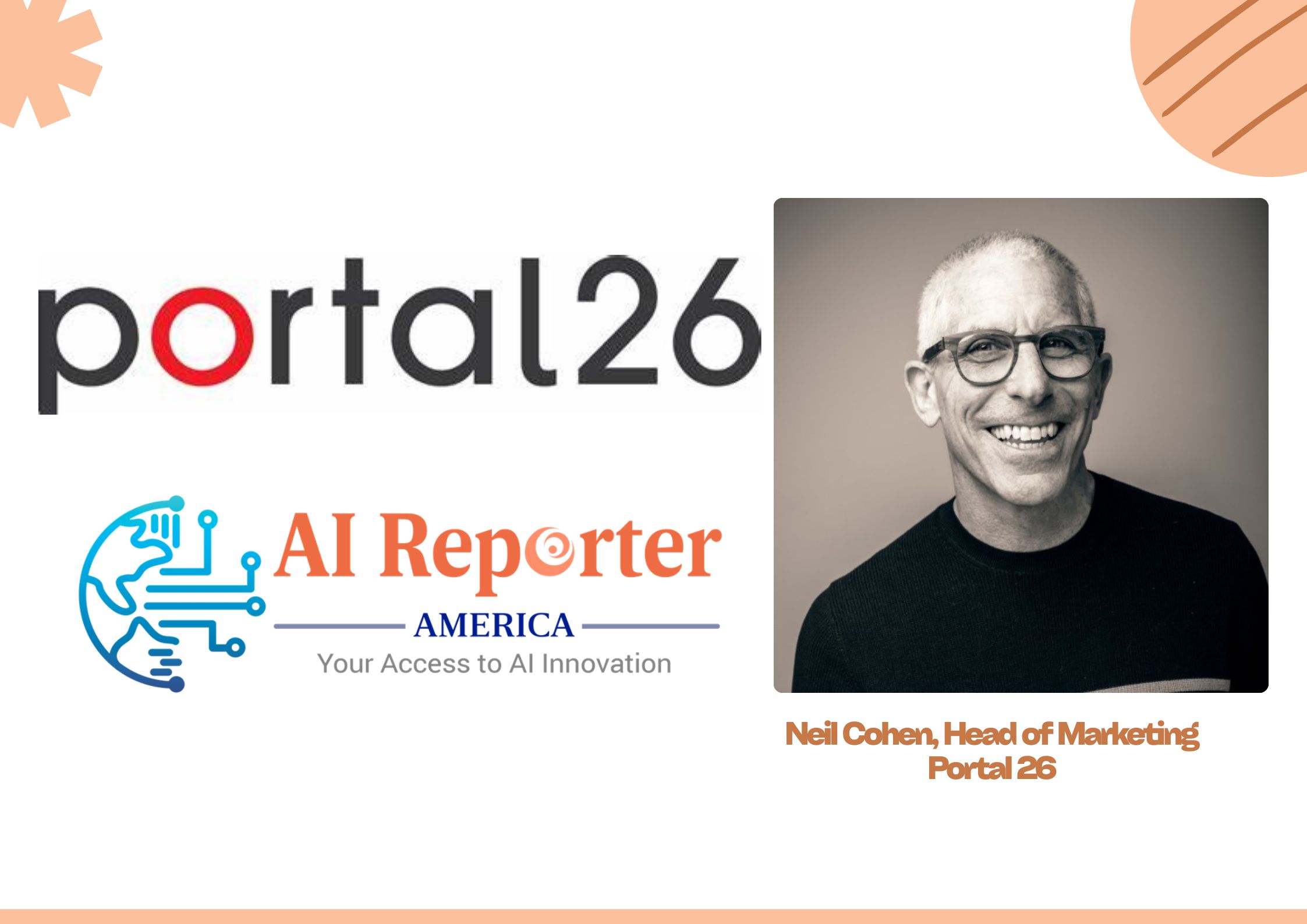
Image source: Public Domain
As enterprise adoption of Claude continues to accelerate, organizations are increasingly facing the challenge of securing and governing AI deployments at scale. Addressing this need, Portal26 has introduced what it calls the first free AI governance and security solution purpose-built for Claude environments. The launch underscores a growing industry shift: deploying large language models is no longer enough—organizations must also ensure they are secure, compliant, and delivering measurable business value. In an exclusive conversation with AI Reporter America, Neil Cohen, Head of Marketing,Portal 26 discussed the strategic vision behind the launch and how it aims to help enterprises strengthen AI governance while accelerating responsible AI adoption.
1. What governance challenges prompted this launch for Claude deployments?
Portal26's launch is straightforward but significant: Claude's enterprise adoption has accelerated far beyond the capacity of most organizations' security and governance infrastructure. Adoption is surging at speeds far greater than security budgets can support, and governance and security have taken a big hit as a result, often defeating the very purpose AI was introduced to achieve. In other words, the business case for deploying Claude is undermined by the absence of the controls needed to ensure that deployment is safe and responsible.
Several compounding factors have sharpened this challenge. First, Anthropic itself acknowledged in an April 2026 blog post that while some oversight is being provided, governance and controls are recommended for enterprise deployments, an implicit admission that the model provider alone cannot fill the governance gap. Second, Anthropic now accounts for nearly 30% of enterprise LLM spend, according to early 2026 data, indicating that the scale of ungoverned usage is substantial. Third, organizations are deploying not just Claude the model but also Claude Code for agentic software development and Claude Cowork for collaborative productivity, each of which introduces distinct governance requirements for tool calls, autonomous actions, and multi-agent interactions.
The result is a governance vacuum: enterprises are investing heavily in Claude but lack the infrastructure to discover all usage, surface all interactions, enforce policies in real time, or demonstrate ROI. Portal26's launch is a direct response to this vacuum, and its decision to offer foundational capabilities free of charge reflects a deliberate choice to remove cost as a barrier to responsible adoption.
2. How does Portal26 help enterprises secure AI adoption at scale?
Portal26 positions itself as the only platform that addresses three interconnected challenges simultaneously: visibility into how Claude is being used, security and governance controls to protect data and intellectual property, and analytics that drive measurable business value. This three-part architecture, covering visibility, security, and value realization, is the structural backbone of the platform and reflects a considered view that these challenges cannot be addressed in isolation.
For enterprises trying to scale Claude adoption, the platform offers two tiers. The free tier delivers the foundational capabilities needed to establish governance without requiring procurement cycles or budget approvals. These include user, model, and agent discovery; agent access graphs; tool call visibility; token usage and cost tracking; and access to conversation threads. These capabilities give security and IT teams immediate insight into who is using Claude, how agents are interacting with tools, and what the usage cost profile looks like.
The paid tier extends this foundation into comprehensive enterprise security, adding real-time security policy enforcement; MCP controls and policy enforcement; token policy and cost enforcement; enterprise integrations with identity providers, single sign-on systems, SIEM platforms, and incident response tools; and access and privacy controls. Taken together, these capabilities allow enterprises to move from reactive governance, discovering problems after they occur, to proactive governance, in which policies are enforced before harmful interactions can occur.
Portal26 also emphasizes speed of deployment, noting that the free offering can be set up in a few minutes. This is a deliberate design choice aimed at organizations that need to address governance gaps quickly, without the lengthy implementation cycles that characterize traditional enterprise security tooling.
3. What visibility gaps exist in today's enterprise AI environments?
The visibility problem in enterprise AI is multi-dimensional. The first, and perhaps most significant, is Shadow AI: the use of AI tools and models that are neither sanctioned, tracked, nor governed by IT or security teams. Portal26 detects three times more Shadow AI than legacy security providers, suggesting that the problem is both widespread and systematically underestimated by organizations relying on conventional security tools.
Beyond Shadow AI, Portal26 addresses visibility, the ability to see what external tools and APIs an AI agent is invoking, is particularly critical in agentic environments where Claude Code or Claude Cowork may be taking autonomous actions on behalf of users. Without visibility into tool calls, organizations have no way to detect when an agent is accessing sensitive data sources, making external API requests, or performing actions that fall outside sanctioned boundaries.
Agent access graphs represent another dimension of the visibility problem. As organizations deploy multiple agents that interact with one another and with external systems, determining which agent has access to which resources becomes increasingly complex. Without a visual and queryable representation of these access relationships, security teams are effectively blind to the attack surface that agentic AI creates.
Token usage and cost visibility is the final point. In agentic workflows, token consumption can escalate rapidly and unpredictably, creating cost exposure that is difficult to detect and attribute without dedicated tooling. The ability to track token usage at a granular level, by user, by agent, and by use case, is therefore both a financial governance requirement and a security signal, since anomalous token usage can indicate runaway agents or misuse.
4. How do governance controls improve trust and compliance for AI systems?
Governance controls serve two distinct but related functions in enterprise AI environments: they reduce risk, and they build the evidentiary record that allows organizations to demonstrate compliance to regulators, auditors, and internal stakeholders. Portal26's platform addresses both functions through a combination of real-time enforcement capabilities and forensic audit tools.
On the risk reduction side, real-time security policy enforcement is the most direct control available. Rather than reviewing logs after the fact, inline policy enforcement intercepts and evaluates interactions as they occur, allowing organizations to block or modify prompts and responses that violate data handling policies, contain sensitive information, or exhibit indicators of misuse. This is particularly important in regulated industries such as finance, insurance, and healthcare, where the exposure of protected information through an AI interaction could trigger regulatory consequences.
MCP controls, which govern how Claude interacts with external tools and data sources, are especially relevant as agentic AI use grows. The ability to define and enforce policies at the MCP layer means that organizations can control not just what Claude says, but what it does: which tools it can invoke, which data sources it can access, and under what conditions it can take autonomous actions.
On the compliance side, Portal26's forensic audit capabilities, including a NIST FIPS certified AI forensic audit vault, provide the tamper-evident, discoverable record that regulators increasingly require. The ability to retrieve and present a complete audit trail of AI interactions, with cryptographic assurance of its integrity, is a foundational requirement for organizations operating under frameworks such as SOC 2, HIPAA, or the EU AI Act. Governance controls, in this sense, are not merely risk mitigation tools but the infrastructure that makes responsible AI adoption defensible.
5. How do you see AI governance evolving as agentic AI grows?
AI governance is moving away from prompt-level oversight and toward agent-level management. The prominence of agentic AI management, agentic token controls, and agent access graphs in Portal26's feature set recognizes that the governance paradigm built for conversational AI, where a human types a prompt and receives a response, is insufficient for agentic AI, where autonomous agents take sequences of actions, invoke external tools, and interact with other agents over extended time horizons.
As agentic AI grows, governance will need to evolve along several dimensions. First, the unit of governance will shift from individual interactions to workflows and task chains. Governing a single prompt exchange is relatively straightforward; governing an agentic workflow that spans dozens of tool calls, multiple data sources, and potentially hours of autonomous execution requires a fundamentally different approach, one based on policy enforcement at the workflow level with the ability to pause, redirect, or terminate agent activity based on observed behavior.
Second, cost governance will become inseparable from security governance. Portal26's agentic token control capabilities, reflect the emerging reality that runaway token consumption is not just a financial risk but a security signal. An agent consuming tokens at an anomalous rate may be caught in a loop, responding to adversarial inputs, or being used to exfiltrate information through a series of API calls. Cost controls and security controls are therefore two sides of the same coin in agentic environments.
Third, the governance of multi-agent systems will require new tools and frameworks. Agent access graphs, offered in Portal26's platform, are an early indication of what this looks like in practice: a visual and queryable representation of the relationships between agents, the tools they can access, and the data they can touch. As organizations deploy increasingly complex networks of agents, the ability to understand and govern these relationships at scale will become a core competency for enterprise security teams.
6. What risks do organizations commonly overlook when deploying AI?
There are three categories of risk that organizations commonly underestimate or overlook entirely: ungoverned AI usage, unprotected data and intellectual property, and the inability to quantify ROI.
Ungoverned AI usage, or Shadow AI, is perhaps the most pervasive and least well-understood risk. When employees adopt AI tools without IT or security oversight, organizations lose visibility into how sensitive data is being used, which models are being accessed, and what policies are being circumvented. Portal26's claim to detect three times more Shadow AI than legacy security providers suggests that the problem is both more widespread and more difficult to detect than most organizations appreciate. Shadow AI is not merely a policy violation; it is an active data exfiltration risk, a compliance liability, and a source of uncontrolled cost.
Data and IP protection risks are closely related but distinct. Even in sanctioned Claude deployments, employees may inadvertently or deliberately submit proprietary information, customer data, or regulated content to the model. Without inline prompt protection and data classification controls, organizations have no mechanism to prevent this exposure. The risk is compounded in agentic deployments, where agents may access sensitive data sources autonomously and surface that data in ways that are difficult to monitor without dedicated tooling.
The ROI quantification gap is a risk that is often overlooked because it does not manifest as a security incident. When organizations cannot demonstrate the value of their AI investments, programs stall, budgets are cut, and the long-term competitiveness benefits of AI adoption are foregone. Portal26's emphasis on value realization, including analytics that track AI KPIs and compare outcomes against industry benchmarks, reflects a view that governance is not just about risk mitigation but about enabling sustained, defensible AI investment.
7. How does this launch support Portal26's long-term AI security vision?
Portal26's long-term vision is to serve as the management layer that sits across the full lifecycle of enterprise AI adoption, from initial discovery and security through to ROI measurement and value realization. The free offering for Claude deployments is a strategically significant move in pursuit of this vision for several reasons.
First, Portal26 is the default governance layer for Claude in enterprise environments. By removing cost as a barrier to entry and enabling deployment in minutes, Portal26 can embed itself in the governance workflows of a large number of organizations before competing offerings have the opportunity to do so. The free tier is explicitly designed to be a pathway to the paid platform: once organizations experience the value of real-time visibility and discover the gaps in their governance posture, the case for upgrading to the full platform becomes straightforward.
Second, the launch reinforces Portal26's positioning as a Claude-native governance platform at a moment when Anthropic accounts for nearly 30% of enterprise LLM spend and is increasingly weekly.. Rather than offering a generic AI governance platform that covers multiple model providers, Portal26’s expertise in the specific challenges of Claude governance, including Claude Code, Claude Cowork, and the emerging MCP ecosystem, and is building its brand around that specialization.
Third, the emphasis on agentic AI management puts Portal26 ahead of where the market is heading. Most enterprise AI governance tools today are built around the conversational AI paradigm. Portal26's agentic token controls, agent access graphs, and MCP policy enforcement capabilities represent a bet that agentic AI will become the dominant enterprise deployment pattern over the next few years, and that organizations will need a dedicated management layer to govern it safely. By building these capabilities now and making them accessible through a free entry point, Portal26 will be the platform of choice when that transition accelerates.
The company's track record supports this ambition. With a 24x ROI advantage over industry benchmarks, 3x more Shadow AI detection than legacy providers, and 10x more security coverage, Portal26 enters this market position from a point of demonstrated product maturity. The free Claude offering is not a standalone product; it is the front door to a full-lifecycle AI adoption management platform that has been tested and validated in Fortune 500 environments, regulated industries, and major utilities. That combination of accessibility and enterprise credibility is what makes this launch a meaningful development in the evolving landscape of AI governance.