Friday, 18 September 2026

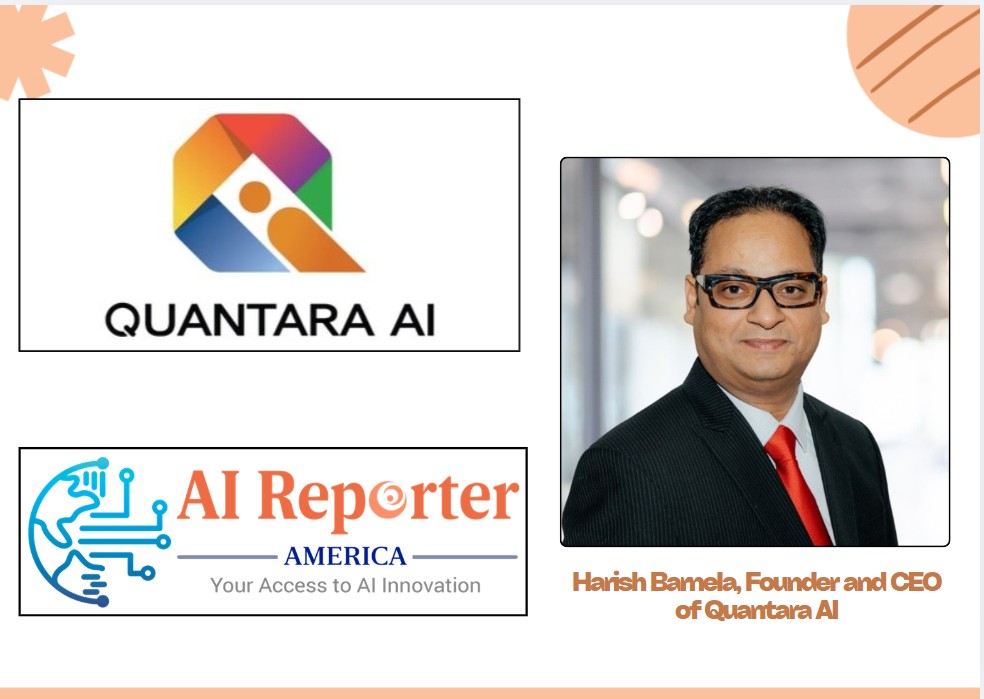
Most enterprises already have a broad security stack spanning vulnerability management, endpoint protection, cloud security, identity, SIEM, application security, threat intelligence, GRC, and other specialized tools. While each point solution can be effective within its intended role, their findings are often generated in separate systems, using different scoring methods and with limited visibility into the business asset, process, data, or financial consequences involved. This lack of context has become a central cyber risk challenge for businesses: identifying which exposures could materially affect the company, estimating their potential cost, determining which issues deserve attention first, and measuring how much risk was actually reduced after investment. In an exclusive conversation with AI Reporter America, Harish Barnela, Founder and CEO of Quantara AI, shared insights into how the company is addressing these challenges by helping organizations connect cyber risk with business impact and make more informed security decisions
1. What drove Quantara to build an AI Agent Network focused on financially quantifying cyber risk?
Those questions are what drove us to build the Agent Network. Organizations already have strong point solutions and large amounts of technical evidence. What is often missing is the context that connects a finding to the asset it affects, the business service that asset supports, the threat activity around it, the controls already in place, and the financial consequence if the scenario occurs. Without that chain of context, a critical finding can still be difficult to compare with hundreds or thousands of other issues competing for the same people, budget, and executive attention.
Quantara's AI Agent Network is designed to build and maintain that context continuously. Specialized groups of agents connect technical exposure, threat intelligence, control effectiveness, business context, and financial impact so organizations can ask practical questions in business terms: What could happen? How likely is it? What could it cost? What should we do first? And what measurable risk reduction should we expect from that action?
The goal is not AI for its own sake. It is to move the conversation from “What is critical?” to “What matters most to the business, why does it matter, and what action will reduce the most risk?”
2. How does the platform convert thousands of technical findings into dollar-based business exposure?
Quantara starts with the asset and the business service around it. A vulnerability by itself has limited financial meaning. The same vulnerability can represent very different risk on an isolated test server versus an internet-facing production system that supports revenue, contains sensitive data, or has a low recovery tolerance. The platform therefore evaluates where the finding exists, what the asset does, who owns it, what data and business processes depend on it, whether the exposure is reachable, what threat activity is relevant, and what preventive or compensating controls are already in place.
The platform then ingests and normalizes data from the existing security and business environment. That can include vulnerability management, EDR, SIEM, CSPM, application security, identity, DLP, GRC, asset inventories, business-unit information, sensitive-data volumes, revenue dependencies, and recovery requirements. Findings are linked to assets and grouped into business-relevant scenarios rather than treated as independent rows in a backlog.
That grouping matters. Ten vulnerabilities, two cloud misconfigurations, and a weak identity control may all contribute to one plausible compromise path against the same business service. Counting each item as a separate business risk can exaggerate exposure. Quantara instead relates the evidence to scenarios such as ransomware disruption, sensitive-data compromise, fraud, or business interruption, then estimates the likelihood and financial impact of those scenarios.
From there, the platform estimates probability and potential loss using a range of outcomes rather than a single deterministic value. That financial view can be expressed as expected loss, Value at Risk, loss distribution, or residual risk, depending on the decision being made. The important point is traceability: a user can move from the financial estimate back to the scenario, business asset, controls, threat evidence, and original technical findings that produced it.
3. What makes Quantara’s ROI-based remediation ranking different from traditional severity scoring?
Traditional severity scoring answers a useful technical question: how serious is this finding? It does not answer the investment question: if we spend time or money fixing it, how much business risk are we expected to remove?
For example, a CVSS 9.8 vulnerability on a low-value, segmented system with no sensitive data and strong compensating controls may create less expected loss than a medium-severity identity or cloud issue affecting a critical application with active threat exposure. Quantara keeps technical severity as an input, but adds asset criticality, business impact, threat activity, control effectiveness, implementation cost, and residual risk.
For each mitigation, the platform can compare the current financial exposure with the expected exposure after the action. That makes it possible to estimate risk reduction, compare that reduction with implementation cost, and rank actions by the value they are expected to create. The practical shift is from 'fix the highest score first' to 'which action removes the most material risk for the resources available?'
That ranking can also compare very different choices on the same economic basis. Patching a vulnerability, strengthening identity controls, segmenting a network, improving recovery capability, adding a security control, accepting residual risk, or transferring part of the risk through insurance can all be evaluated by the change they are expected to make to the organization's exposure. The goal is not to replace technical judgment; it is to give that judgment a business and financial frame.
4. How do the specialized AI agents collaborate across exposure, threat, control, and business data?
Quantara is designed as an Agent Network rather than one general-purpose model trying to reason across the entire cyber environment. Different groups of agents have specific responsibilities, and they exchange structured evidence as the analysis moves from raw telemetry to a business decision.
Ingest Agents connect and normalize signals from security, threat, control, and business systems. Context Agents then establish what those signals mean to the organization by linking findings to assets, business units, critical processes, sensitive data, revenue dependencies, recovery requirements, and other enterprise context. Quantify Agents combine that context with threat and control evidence to estimate likelihood, loss magnitude, Value at Risk, residual risk, and other financial measures.
Govern Agents apply the organization's risk appetite, assumptions, frameworks, policy requirements, and approval thresholds. Act Agents take approved outcomes into operational workflows, such as ticketing or the quantitative risk register, track remediation status, and feed completion data back into the risk model.
A simple example shows how the groups work together. An Ingest Agent may receive a new vulnerability and threat signal. A Context Agent establishes that the affected server supports a revenue-critical service and contains sensitive data. Quantify Agents update the scenario's likelihood and financial exposure. Govern Agents check the proposed response against risk appetite and policy. Once a human approves the action, Act Agents can route the remediation into the existing workflow and track whether the modeled exposure changes after completion.
5. How does Quantara ensure AI-driven recommendations remain defensible, governed, and human-approved?
For enterprise cyber risk, explainability is essential. A recommendation has limited value if a CISO cannot show where it came from. Quantara is designed so users can trace a decision back to the underlying findings, threat information, controls, business assumptions, and quantification logic.
The platform also separates AI-assisted interpretation from governed calculations and decision authority. AI can help correlate information, identify relationships, interpret threat intelligence, develop scenarios, and recommend possible responses. Material risk decisions still operate within defined models, organizational thresholds, and approval processes.
Our philosophy is straightforward: automate the analysis aggressively, but govern the decisions appropriately. Agentic does not have to mean uncontrolled autonomy. Human approval remains central for decisions such as accepting material risk, authorizing major remediation investment, or changing the organization’s risk position.
6. What challenges arise when translating constantly changing cyber threats into financial risk estimates?
The first challenge is time. Cyber risk changes whenever the environment changes: a new vulnerability is disclosed, exploit code appears, an asset becomes internet-facing, a control fails, an application moves, a business service becomes more critical, or new threat intelligence changes the likelihood of a scenario. A financial estimate created once a quarter or once a year can therefore become stale while the underlying exposure is still moving.
The second challenge is uncertainty. Asset inventories can be incomplete, business ownership can be missing, threat data changes, and loss estimates are inherently probabilistic. A credible model should therefore show ranges, assumptions, confidence, and loss distributions instead of presenting one precise-looking number as certainty.
The third challenge is correlation. Thousands of findings may share the same asset, attack path, control weakness, or loss scenario. Treating them as independent risks can double-count exposure. Quantara uses an asset- and scenario-centric model to group related evidence, then recalculates the financial view as technical, threat, control, and business inputs change.
Continuous recalculation is therefore more than refreshing a dashboard. If a previously low-priority vulnerability becomes actively exploited, the likelihood can increase. If a compensating control is deployed, the likelihood or loss magnitude may fall. If the underlying business service becomes more important, the financial consequence can increase even when the technical finding itself has not changed. The model needs to reflect those changes without losing the assumptions and evidence behind the prior estimate.
7. How could Quantara’s agentic approach change how CISOs and boards prioritize cybersecurity investments?
The biggest change is in the decision itself. A CISO can walk into a meeting with thousands of critical findings, but the board still has to decide what deserves funding now, what can wait, what should be transferred, and what risk the organization is willing to retain. Agentic risk intelligence can translate that technical backlog into a smaller number of business scenarios and financially comparable actions.
Instead of saying, for example, that the organization has 12,000 critical vulnerabilities, the CISO can explain that a small number of scenarios account for the largest concentration of modeled financial exposure, identify the assets and controls behind those scenarios, and show which actions are expected to reduce the most risk. That gives the CFO a way to evaluate the economics and gives the board a clearer view of residual exposure after the proposed investment.
That is the larger promise of agentic cyber risk intelligence. The value is not simply faster automation or another dashboard. It is a shorter, traceable path from a technical signal to a business decision: understand the asset and scenario, quantify the potential loss, compare the available actions, approve the right response, and measure what changed.
Quantara AI
Quantara AI is a continuous, asset-centric cyber risk decision layer that connects technical evidence to business context, quantifies exposure in financial terms, and helps organizations prioritize the actions that reduce the most risk.