Monday, 12 October 2026


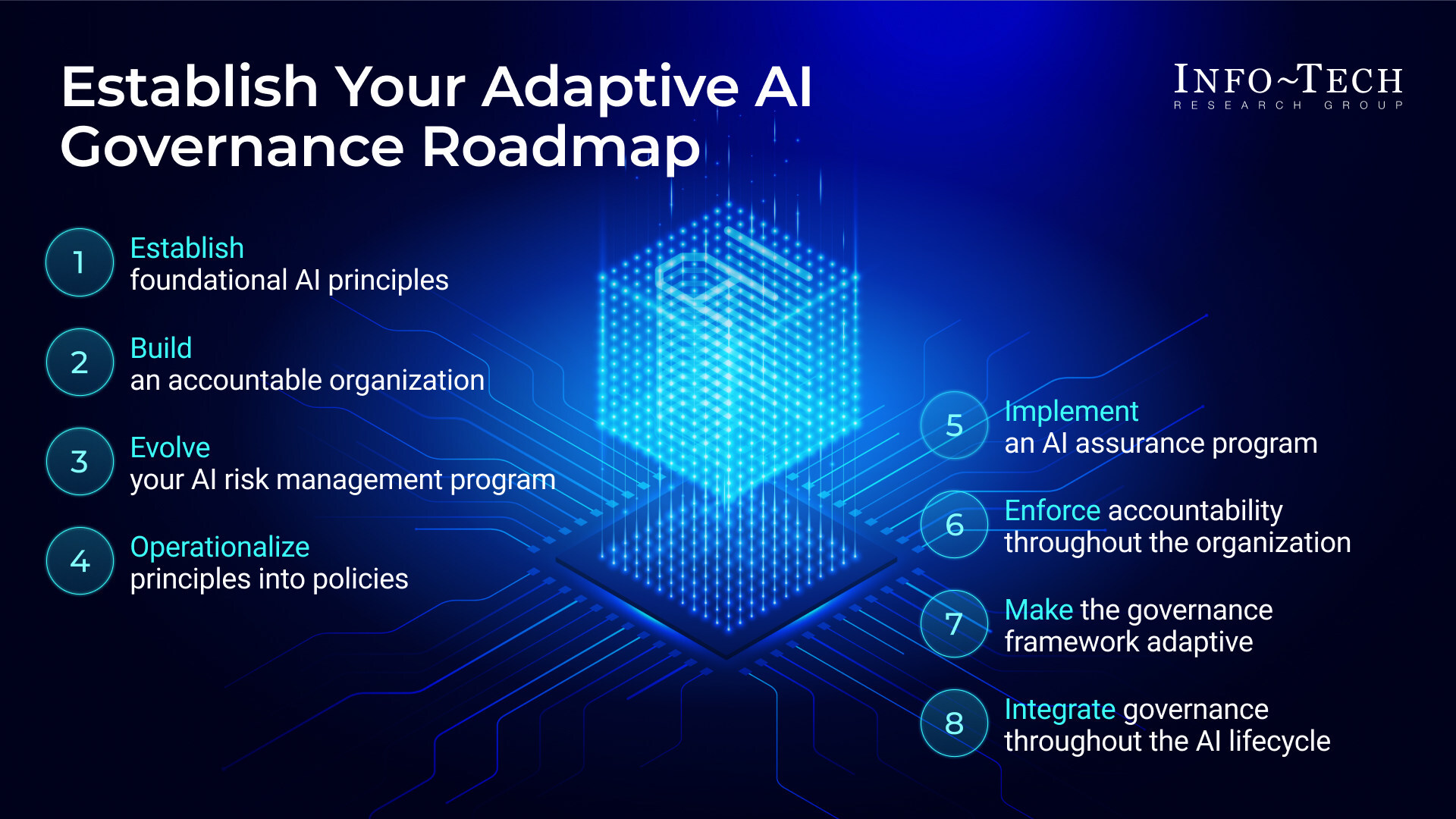
Image Courtesy: Public Domain
As enterprises adopt increasingly autonomous AI systems, traditional governance models are proving too static to keep pace with emerging risks, regulatory change, and growing accountability demands. Info-Tech Research Group's new blueprint, Establish Your Adaptive AI Governance Program: From Principles to Practice, outlines a practical, ten-phase approach to help organizations govern AI dynamically across its lifecycle while balancing innovation with accountability.
Traditional AI governance models are becoming less effective as organizations adopt agentic AI systems that can reason, act, and adapt with increasing autonomy. To help IT leaders respond, Info-Tech Research Group has published its blueprint, Establish Your Adaptive AI Governance Program: From Principles to Practice, designed to help organizations build AI governance that evolves alongside emerging risks, technologies, and regulatory requirements.
According to Info-Tech's findings, governance approaches built around periodic reviews or siloed compliance functions are struggling to keep pace as AI systems move beyond narrow, task-specific use cases. The firm's blueprint introduces adaptive AI governance as a dynamic, system-oriented model that integrates continuous monitoring, real-time risk detection, and feedback loops throughout the AI lifecycle.
The blueprint also emphasizes that adaptive AI governance cannot be treated as a compliance-only function. As agentic AI systems become more autonomous, organizations face growing pressure to clarify accountability, strengthen oversight, and ensure governance can respond in near real time without slowing innovation.
"Adaptive AI governance represents a fundamental shift from static oversight to continuous, system-level governance," says Bill Wong, research fellow at Info-Tech Research Group. "As agentic AI systems become more autonomous, organizations need governance frameworks that can evolve in near real time to address emerging risks while still enabling value creation."
Info-Tech's Ten-Phase Framework for Adaptive AI Governance
Info-Tech's Establish Your Adaptive AI Governance Program: From Principles to Practice blueprint provides a structured, end-to-end methodology that guides organizations through ten key phases required to build and sustain an adaptive AI governance program:
Together, these phases help organizations move beyond ad hoc or siloed governance efforts and embed governance across all stages of the AI lifecycle, from planning and design through deployment, monitoring, and eventual decommissioning.
Info-Tech's resource further emphasizes that adaptive AI governance is a shared organizational responsibility, requiring participation from executive leadership, legal and risk teams, developers, data scientists, and other stakeholders. By integrating governance throughout the AI lifecycle, organizations can proactively identify governance gaps, strengthen alignment with foundational AI principles, and respond more effectively to changing regulatory and technological conditions.
The global research and advisory firm's blueprint is supported by practical tools that help organizations operationalize governance, including an AI governance maturity assessment, AI risk assessment templates, AI policy and committee charter templates, and an executive-ready roadmap presentation. Together, these materials help leaders translate governance principles into actionable practices that support both responsible AI use and measurable business value.