Tuesday, 29 September 2026


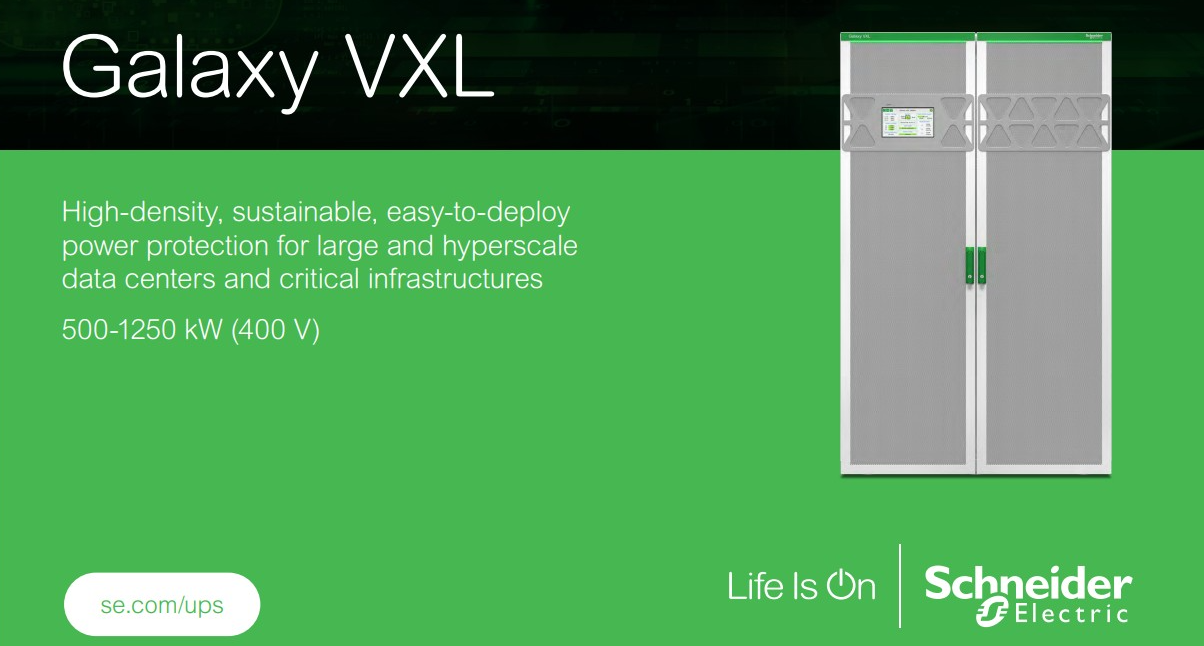
Image source: Public Domain
Schneider Electric, a global energy technology leader, launched new power solutions at YOTTA 2026 to accelerate AI-ready data center deployment and scaling. These solutions span medium-voltage distribution and high-density power infrastructure, allowing electrical systems to evolve at the same pace as the AI factories and digital services they support. At the center of the offering is the world's first fully Software-Defined Medium Voltage switchgear, now deployed in a live colocation data center with Equinix.
"The challenge facing data center operators today is not just keeping pace with AI growth, but building the resilient, efficient and scalable power infrastructure needed for an increasingly digital world," said Frédéric Godemel, Executive Vice President, Energy Management, Schneider Electric. "Schneider Electric's Software-Defined Medium Voltage architecture brings a new level of flexibility, standardization, and energy intelligence to electrical distribution, helping customers scale their operations more efficiently while preparing for future requirements. By combining software, connectivity, and sustainable innovation, we are enabling the next generation of resilient and efficient data centers."
Software-Defined Medium Voltage establishes a new category of power infrastructure
Building on its broader Software-Defined Energy vision, Schneider Electric is extending software-defined architecture to medium-voltage power infrastructure. The approach decouples system intelligence from physical hardware, creating a new model for designing, deploying and operating electrical infrastructure that can evolve at the same pace as the AI factories and digital services they support.
Based on the comparison documented in Schneider Electric White Paper 303, the approach enables up to 3× faster ordering and manufacturing, up to 2× faster commissioning and onsite acceptance testing, compared with conventional engineered-to-order medium-voltage switchgear. It also reduces system complexity: in the 20-panel comparison, the software-defined configuration used 87% less control wiring, 91% fewer terminals and 85% less copper in that wiring, while providing digital connectivity and analytics for greater operational visibility.
Key elements of the Software-Defined MV architecture include:
The Software-Defined MV approach has been deployed in live operation through a pilot with Equinix in a colocation data center environment.
Pilot programs continue through 2027, with broader availability to follow in 2028. To learn more, visit the Software-Defined MV switchgear page or read the Software-Defined MV white paper. To receive product and availability updates, register your interest.
RM AirSeT 38 Software Defined extends SF₆-free MV gas-insulated switchgear to 38 kV
Schneider Electric also announced RM AirSeT™ 38 Software Defined, part of its proven AirSeT™ platform of SF₆-free secondary medium-voltage gas-insulated switchgear (GIS). RM AirSeT 38 extends the platform from 24 kV to 38 kV and is designed specifically for next-generation AI data centers.
As AI, high-performance computing and large-scale digital infrastructure drive rising power densities, many operators are planning 36/38 kV MV architectures to support higher power capacity, simplified MV backbone design, and scalable campus deployment. RM AirSeT 38 meets that need, giving hyperscalers and colocation providers greater flexibility as they modernize their electrical distribution strategies.
RM AirSeT 38 is designed to support high-density, scalable deployments through:
Order intake is planned to begin in 2027, with first deliveries expected in 2028. To receive updates on RM AirSeT 38, register your interest.
Galaxy VXL brings high-density UPS power to AI-ready data centers
Schneider Electric also highlighted Galaxy VXL, its latest high-density, modular uninterruptible power supply (UPS) for next-generation AI-ready data centers and large-scale digital infrastructure. Built for the power demands of AI workloads, Galaxy VXL combines industry-leading power density, operational efficiency, and resiliency in an ultra-compact footprint.
As AI deployments drive higher rack densities and more dynamic load profiles, data center operators need power infrastructure that responds quickly to fluctuating demand while maximizing white space. Galaxy VXL helps customers maintain reliable, high-quality power delivery for scalable growth and continuity in AI and high-performance computing environments.
Key benefits include:
Availability
Galaxy VXL is available globally and supports both Lithium-ion and VRLA battery technologies, providing customers with flexible energy storage options to meet their resiliency, performance, and sustainability requirements.