Thursday, 19 November 2026

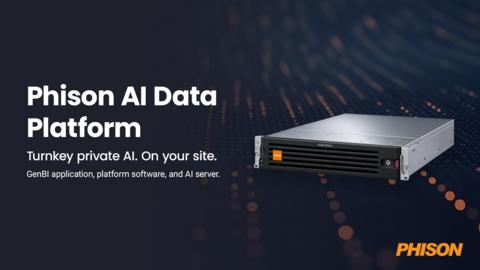
Image source: Public Domain
Phison Electronics (TW:8299TT), a global leader in NAND flash storage solutions, announced the launch of the Phison AI Data Platform (AIDP) with generative business intelligence (GenBI), a turnkey, sovereign AI system that will be showcased at Supercomputing 2026 (SC26) in booth #5413. Powered by Pascari aiDAPTIV ™ Cache Memory technology, Phison AIDP combines locally hosted AI models, integrated inference services, governed analytics and persistent enterprise storage to help organizations unlock business intelligence while maintaining control over their data, infrastructure and AI operations.
As AI reshapes the competitive landscape, organizations today are facing shrinking time-to-market windows to capture revenue opportunities and service evolving customer demands. Solving this with traditional business intelligence tools would rely on predefined dashboards, queries and filters, requiring manual intervention to uncover new insights. This slows analysis and updates, particularly in regulated industries where external data transfer restrictions limit automation.
Phison AIDP addresses these challenges by combining AI infrastructure, locally hosted models and enterprise applications into a sovereign AI platform. Through its integration with Wren AI, the platform enables business users and AI agents to ask questions in natural language, generate SQL-backed insights and create interactive analytical dashboards using existing enterprise data. Wren AI's governed context layer grounds analysis in approved business definitions, relationships and access policies, helping organizations deliver more consistent, trustworthy business intelligence. In tandem, Phison’s partnership with TrueNAS brings enterprise data protection and customer-controlled storage services to private AI deployments, establishing a foundation for broader persistent data services and enterprise AI resilience.
“Today, enterprise AI requires more than generating insights. It demands predictable performance, persistent memory and control over critical data,” said Michael Wu, GM and President, Phison US. “At Phison, protecting and storing critical organizational data has been our commitment for 26 years. Phison AIDP is a natural evolution of this promise to enable sovereign AI deployment with greater model flexibility, performance visibility and sovereign data control, laying the foundation for next-generation hyperconverged infrastructure.”
“Enterprise teams need AI that can answer specific operational questions using their own data and business definitions,” said Howard Chi, Co-founder and CEO of Wren AI. “In manufacturing, that could mean identifying which suppliers are contributing to production delays. In healthcare, it could mean analyzing patient wait times and capacity across departments. For financial institutions, it could mean investigating changes in loan portfolio performance or exposure across customer segments. Combined with Phison’s optimized private AI infrastructure, we’re enabling organizations to scale AI-powered analytics while maintaining control over their data, models, and operations.”
“TrueNAS is the first enterprise storage partner for the Phison AI Data Platform,” said Jamila Gunawardena, Director of Solutions and Alliances, TrueNAS. “Enterprise customers need effective, trustworthy private AI solutions that deliver data sovereignty while lowering costs. TrueNAS brings high-performance data services, customer-controlled storage and data protection to AI workloads, beginning with an independent, on-premises storage target for GenBI backup and restore. As the platform grows, we look forward to collaborating with Phison on the broader data governance requirements of enterprise AI.”
Features and benefits of Phison AIDP include:
Sovereign AI and Model Freedom
High-Performance Enterprise AI Inference
Persistent Enterprise Intelligence and Open Storage
Availability
Phison AIDP with GenBI is available now, with deployments tailored to each organization’s unique requirements. Phison works closely with customers to assess their data environments and business intelligence needs, configure the appropriate system and integrate and optimize the solution alongside their data teams.