Wednesday, 07 October 2026



As competitive markets evolve faster than traditional research cycles can keep pace, businesses increasingly need timely intelligence that goes beyond simply monitoring competitors. AI is changing the economics of competitive research by making market signals easier to gather, analyze, and translate into actionable decisions. In an exclusive conversation with AI Reporter America, Catherine Beck, CEO and Co-Founder of Rival Shark, discussed how the company’s AI-powered market intelligence platform is helping businesses turn competitive signals into timely recommendations, identify local market opportunities, and make more informed strategic decisions.
1. What inspired the launch of Rival Shark's AI competitive intelligence platform?
Most businesses do not learn that a competitor changed pricing, entered their market, or launched a new product from a research report. They learn it from the customer they lost.
We did not start with an AI idea. We started with that pattern, which we had both watched play out repeatedly inside large organizations.
Competitive intelligence is not a hard problem for a Fortune 100 company. It is a staffed one. There is a team, a research budget, an enterprise platform that can cost tens of thousands of dollars a year before accounting for the people required to interpret what it returns, and a standing meeting where someone briefs leadership on what changed.
The same question sounds completely different depending on where you sit. In a Fortune 100 company, "what is our closest competitor doing on pricing?" produces a research deck two weeks to 3 months later. In a 40-person business, it produces 30 browser tabs, a Slack thread that dies on Thursday, and a decision eventually made on instinct.
The signals themselves are already public. Job postings, review sites, press releases, product pages, local listings, regulatory filings. What most companies lack is the labor to find them, the discipline to do it on a schedule, and the analysis that turns them into something a leader can act on.
That is an access problem wearing the costume of a technology problem. AI changed the economics of the research and synthesis work by a margin most people still have not absorbed. Work that used to require an analyst team can now run continuously, for every customer, at a cost even a small business can carry.
We built Rival Shark as a horizontal platform for that reason. We were advised early and often to pick a vertical, and we declined. The blind spot does not care what industry you are in. A regional HVAC company, a 200-person software business, and a specialty manufacturer all lose deals the same way.
The last piece was personal. We have both been the person who had to explain a miss that better information would have prevented. Our customers are the predator in their market. Our job is to give them the senses.
2. How does Rival Shark turn competitive signals into actionable business decisions?
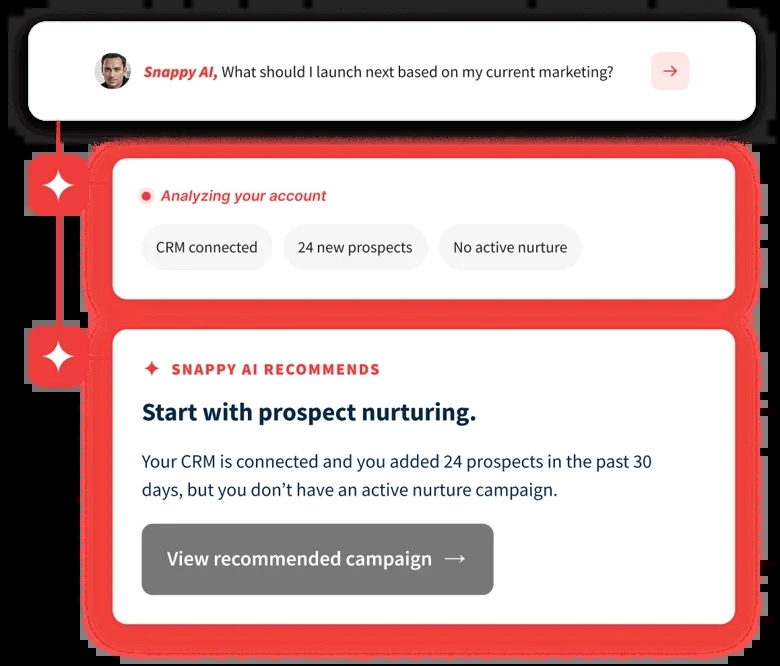
By refusing to ship a signal without a decision attached to it.
Every feature is measured against one question: what should I do about this, and when? A signal that does not answer that is noise wearing a suit. Most competitive intelligence products are strong at gathering and weak at answering, which is why so many end up as dashboards nobody opens after week three.
Three mechanisms make the difference.
Objectives. Before a report runs, the customer tells us what they actually care about. Pricing movement. Hiring velocity. Channel shifts. Local market position. Those objectives are injected into the research itself, so we are not returning a general competitor profile and hoping something in it lands. The same competitor produces a materially different report for a customer worried about talent than for one worried about margin.
Structured output with an owner and an urgency level. Every finding resolves into a recommended action, a timeframe, and the reasoning for why it matters now. We are deliberately strict about urgency. If everything is marked urgent, nothing is, and the customer stops reading. Scarcity of the signal is the signal.
The Actions system. Recommendations do not stay trapped inside the report that produced them. They surface into a working list that persists across reports and report types, alongside actions the customer adds themselves.
That third step is where intelligence becomes operational, and it is the step most tools skip. Reading is not deciding. Deciding is not doing. We wanted the distance between all three measured in clicks.
We also track competitor scores across report cycles, so customers see direction rather than a snapshot. A competitor holding steady is a different strategic situation from one gaining four points a cycle, even when this month's report reads the same.
The internal test is whether a customer could take a report into a leadership meeting and leave with assignments. If the answer is no, the report failed, however accurate it was.
3. What sets the platform apart from traditional competitive intelligence tools?
We synthesize rather than aggregate, we research against the customer's stated priorities rather than a generic profile, and we built for a competitive geography the category has largely ignored.
The established category is built on capture and display. Monitor sources, detect changes, alert the user, and let the user do the analysis. That model assumes the customer has an analyst. Most do not. We do the analytical work and deliver a structured report, with the underlying signals available beneath the conclusion. The customer gets the read, not a feed.
Commodity intelligence is what happens when every customer in a category receives the same competitor profile. Our reports are shaped by the customer's own objectives, company profile, and market position. Two customers tracking the same competitor get different intelligence, because they are asking different questions.
The third difference is the one customers react to most. Most competitive intelligence platforms were designed around national and enterprise-level competition. We built Local Market Intelligence for businesses whose real competitive battlefield is a five, ten, or twenty-five mile radius. When your horizontal market includes a company with three locations in one metro area, national intelligence on its own can be difficult to act on.
There is a fourth difference that is less about features and more about restraint. We treat thin data as a feature rather than a failure. Many competitors are small, private, and barely covered. A platform that returns a confident, detailed profile of a company with almost no public footprint is fabricating, and the customer will find out eventually. When the signal is thin, our reports say so and pivot to category-level intelligence that is actually supportable. We would rather deliver a report that names its limits than one that quietly invents past them.
Underneath all of it is access. The senses a national brand pays tens of thousands of dollars a year for should be reachable by a business with a single location. Removing the analyst team from the cost structure is what makes that possible.
4. How does AI help deliver boardroom-ready intelligence in under 10 minutes?
AI gives us speed. The architecture is designed to protect trust, because speed without grounding is a liability rather than a feature.
Start with why speed matters at all. It is not efficiency. Late intelligence is worth close to nothing. A competitor's pricing move you learn about eight weeks later is history. Speed is the antidote to the specific failure our customers are trying to escape, which is finding out last. The same report delivered after the decision has been made is equally accurate and considerably less valuable.
The reason the work compresses is structural. Traditional research is bounded by how quickly a person can search, read, compare, and reconcile sources. Our research phase pursues many of those paths at once.
But raw speed is where most AI research products fail, so we separated the work into two phases. The first gathers evidence against the customer's competitors, objectives, geography, and industry context. The second builds the analysis and recommendations from that evidence. Blending the two produces confident prose with weak grounding, which is exactly the failure people have in mind when they say they do not trust AI research. Separating them means conclusions trace back to something gathered.
The last piece is the output standard. "Boardroom-ready" gets used loosely, so it is worth defining what we mean. A defined structure a reader can navigate. Findings separated from recommendations. Urgency levels applied with discipline. Specific numbers instead of adjectives. A clean export the customer can hand to someone who has never logged into our platform.
Our competitor reports run nine sections, industry reports six, local market reports eight. That structure is not decoration. It is the difference between a document that survives an executive meeting and a wall of text that does not.
The output arrives fast. What matters is that it arrives while the window is still open.
5. How does Local Market Intelligence help businesses identify market saturation and growth opportunities?
It answers the question most businesses actually have, which is not "who are my competitors" but "how do I rank against them in my market, right now."
A national competitor profile tells a business with one location almost nothing they can act on. Knowing a competitor's overall market share does not tell you whether you are surrounded.
Local Market Intelligence produces a market saturation score from 0 to 100 for a defined radius around the customer's location. The score combines competitive density, competitor quality, growth signals, and demand signals into a single view of how crowded the market is.
The bands map to strategic postures rather than to a grade. A low score points to an underserved market where growth investment is likely to return. A middle score points to healthy competition where differentiation and service quality are the operative levers. A high score points to a market where retention and niche positioning matter more than expansion. A very high score is a prompt to decide whether to defend aggressively or look at adjacent geography.
Underneath the score, the report identifies the top local players with threat levels and local review scores, estimates the customer's rank in their own market, flags the newest entrant, and reports whether density is increasing, stable, or decreasing along with the reasoning behind that trend. Higher tiers add expansion signals such as competitor facility investments, and local pricing and sentiment analysis including the complaint themes competitors are accumulating.
That last piece produces the finding customers act on fastest. A competitor whose national reputation is strong but whose local reviews are weak on a specific, repeated complaint is a targetable opening. That gap is invisible at the national level and obvious at the local one, and a business can act on it tomorrow.
The score also compounds. A single scan tells you where you stand. Successive scans tell you which direction your market is moving, which is the input an expansion or exit decision actually requires.
6. What challenges arise when automating competitive research and strategic analysis?
Some of the hardest problems in this category are not engineering problems. They are trust problems. Being direct about them is more useful than a clean answer would be.
Fabrication. A language model asked to profile a company with a thin public footprint will produce a plausible profile, because producing plausible text is what it does. In competitive intelligence, a plausible fabrication is worse than no report at all, because the customer may act on it. Our defenses are structural: research and synthesis are separated so conclusions trace to gathered material, the report structures require a level of specificity that unfounded claims struggle to satisfy, and thin data is handled explicitly rather than papered over.
Manufactured change. This one is subtle and it took real design work. A competitive intelligence report naturally wants to talk about movement. What shifted, what the momentum is, how the score changed since last time. On a customer's first report there is no last time. Every delta and trend reading on a baseline report is invented by definition. We suppress that entire class of content until a second report of that type exists. Most users will never notice, and it is exactly the kind of decision that determines whether a product deserves trust.
Urgency inflation. Automated systems mark things important because importance is a common register in source material. A customer who sees five urgent items every week will correctly conclude our urgency ratings are decorative. We hold a high bar on the top level and accept that most findings sit below it.
Source quality. Public signals vary enormously in reliability. A regulatory filing and a competitor's own marketing page are not equivalent evidence, and a system that treats them as equivalent produces confident nonsense.
The limit we cannot engineer away. Automation is strong at research and synthesis and has no access to the context that lives inside our customer's head. The system gives the operator the signal and the recommendation. The operator makes the decision. Respecting the customer's expertise is a product principle for us, not modesty.
7. How do you see AI reshaping the future of competitive intelligence and decision-making?
Competitive intelligence stops being a department and becomes a layer.
Historically it has been organized as a function. A team, a budget, a deliverable on a cadence, and a bottleneck between the people who gather intelligence and the people who decide. That structure existed because the labor was expensive. When the labor cost collapses, the structure has no reason to survive. Intelligence becomes continuously available to anyone making a decision instead of something requested, scheduled, and delivered late.
The second shift follows. When gathering is cheap and universal, gathering stops being an advantage. If every company in a category can generate a competent competitive report, the differentiator moves to speed of action and quality of judgment. The advantage goes to organizations that can decide and move, not the ones that can research. I expect a period where a number of companies discover they were never slow at intelligence. They were slow at decisions, and the intelligence function was a convenient place to assign the blame.
The third shift is where we are pointed. If surface-level public information becomes universally accessible, the remaining edge sits in the layers beneath it. Structured public records that take real effort to mine, including filings, patents, permits, and litigation. Proprietary signals no public source contains, such as deal-level win and loss data and observations from operators actually in the market.
The counter-pressure worth naming is volume. As generation gets cheap, the amount of generated content in the world rises sharply, and a meaningful share of what an intelligence system reads next year will itself be machine-produced. Discrimination becomes more valuable than collection. Systems that cannot separate a real signal from a synthetic one will produce increasingly confident garbage, and the trust premium accrues to the ones that can.
Where that leaves the operator is better than most of the anxious framing suggests. The judgment about what a signal means for a specific business, and what risk is worth taking, has not moved. What has moved is who gets to have the signal at all.
For most of the history of business, seeing your market clearly was a function of budget. It is becoming a function of attention. That change is worth far more to the businesses that were locked out than to the ones that were already inside.