Wednesday, 07 October 2026


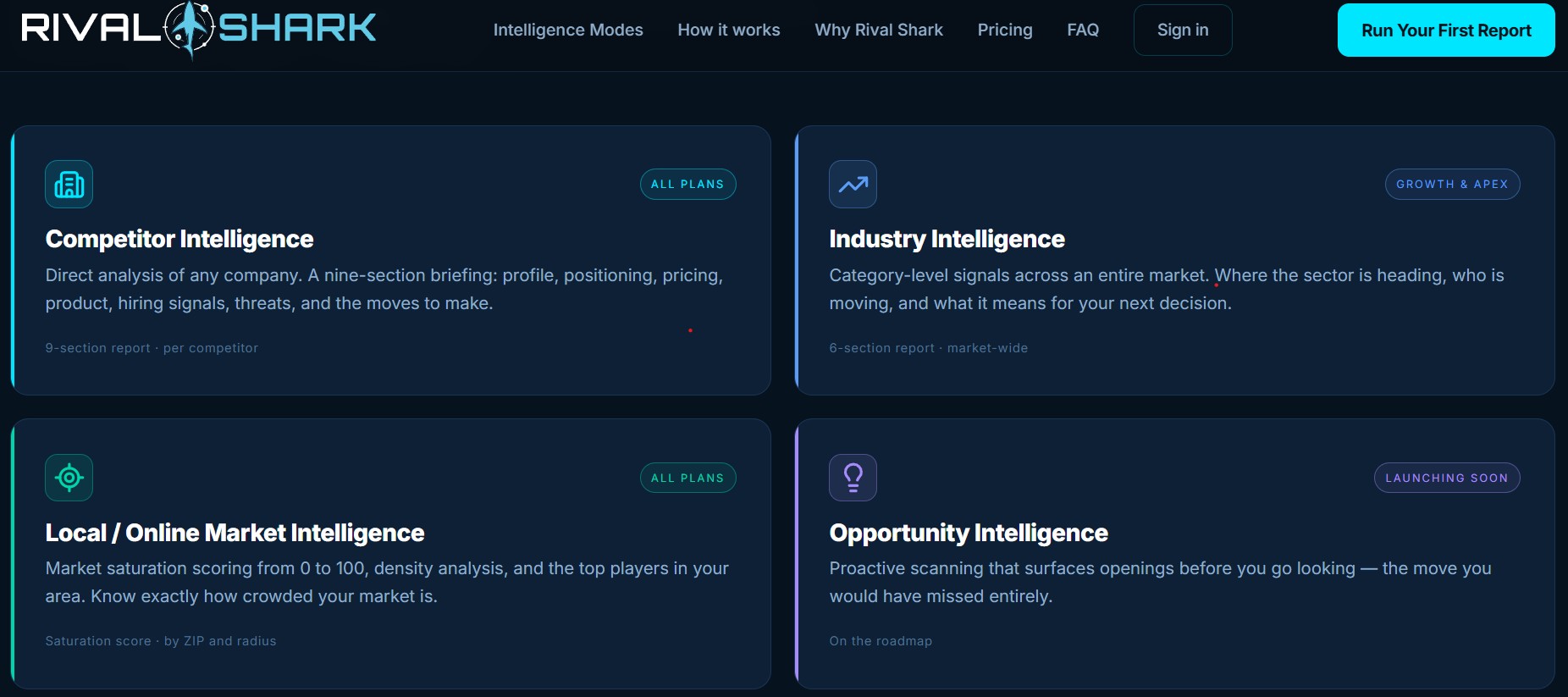
Image source: Public Domain
Rival Shark opened public access to its AI-powered competitive intelligence platform, built for companies that need continuous competitive awareness without standing up a dedicated research team to produce it.
The platform produces a structured intelligence report in under 10 minutes, covering tracked competitors, industry conditions, and local market position. Every finding carries a recommended action, an urgency level, and an assigned owner, so the output moves into a team's operating rhythm rather than sitting in a document nobody opens twice.
"Most businesses learn about a competitor's move after it has already cost them a deal," said Catherine Beck, co-founder and CEO of Rival Shark. "We built the platform so a 40-person company can see that move while there is still time to respond, and do it without hiring an analyst."
Three intelligence modes are live at launch:
Competitor Intelligence produces a nine-section analysis of each tracked competitor, including profiles scored across product, pricing, market position, momentum, and threat, plus recent moves and strategic recommendations. Growth and Apex plans add battle cards and win/loss deal patterns.
Industry Intelligence delivers six sections of category-level analysis covering market size, growth signals, regulatory movement, and technology shifts.
Local Market Intelligence scores a company's local market from 0 to 100 for saturation, maps competitor density within a defined radius, ranks the top local players, and places the company against them. Rival Shark believes it is the first competitive intelligence platform to quantify local market saturation as a scored metric. A fourth mode, Opportunity Intelligence, is scheduled for a future release.
Established competitive intelligence platforms are designed around enterprise workflows and staffed analyst teams, and are priced accordingly. Rival Shark performs the research and synthesis itself, which puts the depth of analysis that has historically required a full-time intelligence team within reach of any company that needs it, from a startup tracking three competitors to a national brand tracking twenty. Research coverage is not limited to domestic rivals, and the platform analyzes competitors and market signals wherever they operate.
Beck said the local scoring is where the gap is widest. "A national market map does not tell an operator whether the territory around each of its locations is already full. That is the question that decides where to invest, where to hold, and where to pull back, and nothing on the market was answering it."